Just War Reconsidered by James M. Dubik
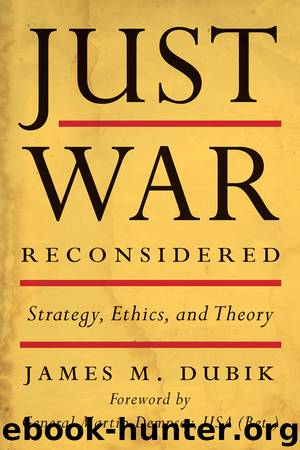
Author:James M. Dubik
Language: eng
Format: epub
Publisher: The University Press of Kentucky
Published: 2016-04-08T04:00:00+00:00
Course of action 1. Maintain the status quo, that is, make progress in Iraq’s move to democracy, transition to Iraqi control, and reduce forces in Iraq toward ultimate withdrawal.
Course of action 2. Shift to a counterinsurgency strategy and surge, increasing the size of US forces in Iraq.
Most of the president’s military and civilian advisers as well as the Iraq Study Group recommended the status quo or some variation of it, but the president chose change. This decision flowed from at least two sources: first, from a very detailed understanding of the political and military situations in Iraq and within the United States; second, from an extensive, extended, and often contentious and iterative set of discussions including the president, his principal national security advisers, active and retired senior military leaders, congressional leaders, think tanks, and academics. Besides the internal review ordered by the president, there were other, independent reviews by military headquarters, think tanks, and government departments. All contributed, directly or indirectly, to the final recommendations made to the president. The final decision was the president’s to make, but the route to that decision was a contentious and inclusive one.60
In the end, Bush changed not only the strategy but also his leadership team. In Iraq, General David Petraeus replaced George Casey, Ambassador Ryan Crocker replaced Zalmay Khalilzad, Admiral William “Fox” Fallon replaced General John Abizaid at Central Command, and Robert Gates became the secretary of defense, replacing Donald Rumsfeld. The result of the second dialogue was twofold. First, it produced unambiguous strategic, political-military unity of purpose: clear strategic direction as well as new strategies, new policies, and a new military campaign to achieve the aims the president set. Second, it established a set of civil and military leaders who were expected to align not only policies but also the bureaucracies they led to execute the new direction and adapt as the war unfolded.
Over the next two years, 2007–2008, the execution of this new direction dramatically reduced the overall violence levels in Iraq, saw the acceleration of Iraqi security force growth in size, capability, and confidence, permitted nascent Sunni reconciliation to spread and Shia militia influence to diminish, and created the opportunity for political solutions that were absent in 2005 and 2006. By mid-2008, US force reductions began, and a Status of Forces Agreement was being negotiated between the United States and Iraq. In 2009, US forces withdrew from Iraqi cities, a move that set the conditions for the ultimate withdrawal of all American forces from Iraq.61 The second dialogue helped contribute to turning potential failure into potential success.
Download
This site does not store any files on its server. We only index and link to content provided by other sites. Please contact the content providers to delete copyright contents if any and email us, we'll remove relevant links or contents immediately.
| Anthropology | Archaeology |
| Philosophy | Politics & Government |
| Social Sciences | Sociology |
| Women's Studies |
The Secret History by Donna Tartt(19085)
The Social Justice Warrior Handbook by Lisa De Pasquale(12190)
Thirteen Reasons Why by Jay Asher(8909)
This Is How You Lose Her by Junot Diaz(6885)
Weapons of Math Destruction by Cathy O'Neil(6279)
Zero to One by Peter Thiel(5801)
Beartown by Fredrik Backman(5751)
The Myth of the Strong Leader by Archie Brown(5507)
The Fire Next Time by James Baldwin(5442)
How Democracies Die by Steven Levitsky & Daniel Ziblatt(5218)
Promise Me, Dad by Joe Biden(5153)
Stone's Rules by Roger Stone(5087)
A Higher Loyalty: Truth, Lies, and Leadership by James Comey(4960)
100 Deadly Skills by Clint Emerson(4924)
Rise and Kill First by Ronen Bergman(4788)
Secrecy World by Jake Bernstein(4752)
The David Icke Guide to the Global Conspiracy (and how to end it) by David Icke(4717)
The Farm by Tom Rob Smith(4507)
The Doomsday Machine by Daniel Ellsberg(4490)
